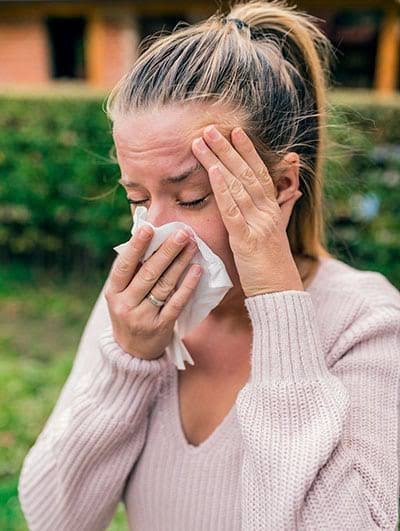
Allergic rhinitis can make daily life a misery. The constant sneezing, the blocked or runny nose, the sinus pressure and the itchy, watering eyes are exhausting, and antihistamines, while helpful, can leave you drowsy. Whether your symptoms come with the season or stay with you all year, they wear you down. At Yuan Qi Acupuncture Center in Business Bay, we use acupuncture and Traditional Chinese Medicine to help ease the symptoms of allergic rhinitis and sinus allergy, as a natural, drug-free form of support alongside your usual care.
In Traditional Chinese Medicine, allergic rhinitis is often understood as a sign of weakened defensive energy, described as a deficiency in Lung and Spleen Qi. When the body's protective barrier is weaker, triggers such as dust and pollen more easily affect the nose and sinuses. Acupuncture aims to support this defensive energy and help calm the body's reaction, with the goal of easing symptoms and supporting your resilience over time.
Allergic Rhinitis (Sinus Allergy) · Business Bay clinic
We reply within working hours. Your details are only used to contact you.
Acupuncture is used to help ease the symptoms of allergic rhinitis, such as a blocked or runny nose, sneezing, sinus pressure and itchy eyes, and to support the body's defences. By stimulating specific points, treatment aims to calm the nasal and sinus reaction and support clearer breathing, which many people find brings welcome relief and better sleep during a flare. Used as a course, particularly ahead of and through your trigger season, it aims to help reduce how much the symptoms affect you.
In Chinese medicine, support is often strongest when treatment begins before the season that usually sets your symptoms off, helping build the body's resilience in advance. We are realistic that responses vary from person to person, and we focus on easing symptoms and supporting your wellbeing rather than promising to remove the allergy itself.

One honest, sensible note: if you have a severe allergy, or any difficulty breathing, please seek medical attention, and if you have asthma or a serious allergy, stay under the care of your doctor. Acupuncture is supportive care that can work alongside your medical treatment to help with the everyday symptoms of allergic rhinitis, rather than a replacement for the care a serious allergy needs.
Allergic rhinitis and sinus allergy show up in several ways. As supportive care, alongside your usual treatment, acupuncture may help ease these.
Sneezing and an itchy nose.
A blocked, stuffy or runny nose.
Sinus pressure and congestion.
Itchy, watering or irritated eyes.
Poor sleep and tiredness during a flare.
That run-down, foggy feeling that comes with constant congestion.
View treatment →Allergies often overlap with skin and immunity concerns — see also psoriasis and eczema, acne and skin problems, and immune support and recovery.
For allergic rhinitis we often complement acupuncture with gentle supporting therapies, guided by the assessment:
Because allergic conditions sometimes come alongside skin symptoms such as hives or eczema, we take a whole-body view and can look at these together where relevant, always as gentle, supportive care alongside your medical treatment.
Your first visit begins with an assessment. We ask about your allergy symptoms, when they happen, what seems to trigger them, whether they are seasonal or year-round, and your medical history, including any medication you take and any asthma or serious allergy. In keeping with Chinese medicine we usually check your tongue and pulse too. We then plan supportive treatment suited to your pattern.
The needles are very fine, far thinner than the needles used for injections, and most people feel little more than a small pinch. Some of the points used are on the face near the sinuses, along with points on the hands, arms and legs, and the session is generally very relaxing. You rest with the needles in place for around twenty to thirty minutes. Afterwards we explain what we found and suggest a realistic schedule, since support for allergies works best over a course, especially around your trigger season.
I visited for spinal treatment and I'm extremely satisfied. The massage and cupping really helped my back pain — the therapists are skilled, knowledgeable and gentle.
 Husnain Awan
Verified · Google
Husnain Awan
Verified · Google
A great experience — acupuncture, massage and cupping in one session. Relaxing and effective, can't wait for the next. Special thanks to Ms. Lei for being so friendly!
 Kyla Galita
Verified · Google
Kyla Galita
Verified · Google
Amazing physiotherapy experience with Ms. Archina! Professional, kind and attentive. Thanks to her care I saw great improvement in a short time. Highly recommend!
 Angeli Orpilla
Verified · Google
Angeli Orpilla
Verified · Google
If allergic rhinitis is making it hard to breathe comfortably and sleep well, supportive treatment can help, and you do not need a referral to see us. Yuan Qi Acupuncture Center is in the Sheikh Majid Building on Sheikh Zayed Road in Business Bay, easy to reach from Downtown, Al Wasl and Jumeirah. Call or message on WhatsApp at +971 50 288 4479 and we will find a time that suits you. Your first consultation is included when you book a course of treatment.
Acupuncture is used as supportive care to help ease the symptoms of allergic rhinitis, such as sneezing, a blocked or runny nose, sinus pressure and itchy eyes. It aims to help with symptoms and support the body's defences, alongside your usual care, rather than curing the allergy.
No. We do not claim acupuncture cures allergies or desensitises the immune system. Its role is to help ease symptoms and support your wellbeing alongside your medical care. Responses vary from person to person.
By stimulating specific points, treatment aims to calm the nasal and sinus reaction and support clearer breathing. Many people find this eases congestion and helps them sleep better during a flare.
Support is often strongest when treatment begins before the season that usually triggers your symptoms, helping build resilience in advance. For year-round symptoms, a steady course works well. We advise you at your assessment.
It depends on whether your symptoms are seasonal or year-round and how strongly they affect you. Many people have a course around their trigger season. We suggest a realistic plan after the assessment.
Most people feel very little. The needles are far thinner than injection needles. You may feel a small pinch, and the session is generally very relaxing, even with points used near the sinuses.
Easing a blocked, stuffy or runny nose is one of the main things acupuncture aims to help with for allergic rhinitis, by calming the nasal reaction and supporting clearer breathing.
Yes. Itchy, watering or irritated eyes are common allergy symptoms, and treatment aims to help ease these as part of supporting the body's reaction to your triggers.
If you have a severe allergy, any difficulty breathing, or asthma, please seek medical attention and stay under your doctor's care. Acupuncture is supportive care for everyday allergy symptoms, not a replacement for the care a serious allergy needs.
Yes. Acupuncture is used alongside your usual treatment, not instead of it, and we do not ask you to stop prescribed medication. Many people hope to rely on it less as symptoms ease, which you can discuss with your doctor.
Yes, when performed by a licensed practitioner with sterile, single-use needles. Side effects are minor, usually slight bruising or short-lived tiredness. Our clinic follows DHA standards.
Yes. Whether your symptoms are seasonal or year-round, treatment can be tailored to your pattern. Year-round symptoms are usually supported with a steady course rather than only a seasonal one.
Where suitable, we may prescribe Chinese herbal medicine alongside acupuncture, tailored to you after a proper assessment, to support your defences and help ease symptoms.
Allergic conditions sometimes come alongside skin symptoms such as hives or eczema. We take a whole-body view and can look at these together where relevant, as supportive care alongside your medical treatment.
We assess your symptoms, their triggers, whether they are seasonal or year-round, and your history, including any asthma or medication, and usually check your tongue and pulse. Then treatment begins, and we explain a realistic plan.
Plan for around 45 minutes to an hour for a first visit, including the assessment. The needles are usually left in place for about 20 to 30 minutes while you rest.
It helps to note when your symptoms are worst and what seems to trigger them, so we can spot the pattern. Eat something light beforehand and wear comfortable clothing.
Yes. The run-down, foggy feeling that comes with ongoing congestion and broken sleep is part of what we aim to help with, by easing symptoms and supporting better rest.
No referral is needed, though we will ask about any asthma, serious allergy or medication and work alongside your care. You can book an allergy assessment by phone, WhatsApp or through our website.
Call or message us on WhatsApp at +971 50 288 4479, or use the booking form on this page, and we will confirm a time that suits you.