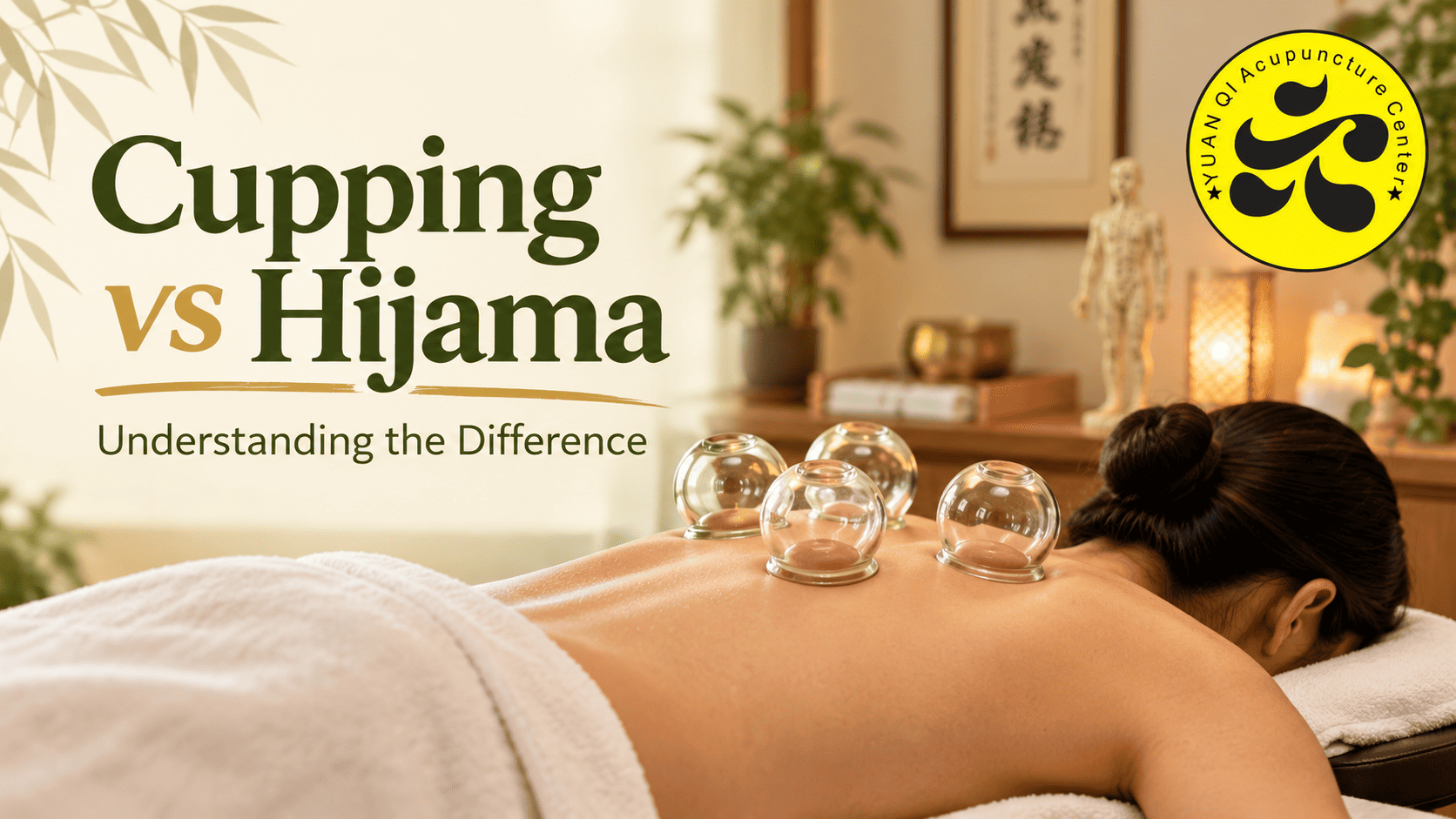
People ask us about cupping vs hijama almost every day, and often they are asking about the same thing without realising it. Hijama is a form of cupping. The difference is one extra step: in Hijama, small superficial cuts are made in the skin before the cups go back on, so a little blood is drawn into them. Ordinary cupping, usually called dry cupping, uses suction alone and leaves the skin unbroken.
That one step changes quite a lot: how the treatment feels, who it is suitable for, how you look after the skin afterwards, and where it can legally be done. We offer both at our clinic in Business Bay, so here is a straight explanation of each, without the exaggerated promises that tend to come with this subject online.
What is the difference between cupping and Hijama?
The difference between cupping and Hijama is whether the skin is broken. Both use cups that create suction on the skin, usually on the back, shoulders or neck. In dry cupping, that is the whole treatment. In Hijama, the cups are first applied briefly, then removed, the skin is lightly scratched or nicked with a sterile blade, and the cups are reapplied so a small amount of blood is drawn up.
| Dry cupping | Hijama (wet cupping) | |
| What happens | Cups create suction on the skin and are left in place or slid along it | Cups are applied, removed, small superficial cuts are made, and the cups go back on |
| Skin broken? | No | Yes, with shallow, controlled cuts |
| Tradition | Traditional Chinese Medicine and many other traditional systems | Prophetic and Islamic medicine, Unani medicine, and also used within Chinese medicine |
| Typical session length | Around 10 to 20 minutes of cupping, often within a longer session | Usually longer, including preparation and dressing the skin |
| What it feels like | A firm pulling sensation, often relaxing | Pulling, plus brief stinging from the cuts |
| Marks afterwards | Round marks that fade over several days to a week or so | Round marks plus small healing cuts |
| Aftercare | Minimal: keep warm, drink water, avoid very hot showers that day | Clean wound care for a few days, avoid swimming and the gym until healed |
| Who should avoid it | Fewer restrictions | More restrictions, including anaemia, blood thinners and pregnancy |
| Where it can be done | A clinic setting | Only in a licensed medical centre in the UAE, not at home |
What is cupping?
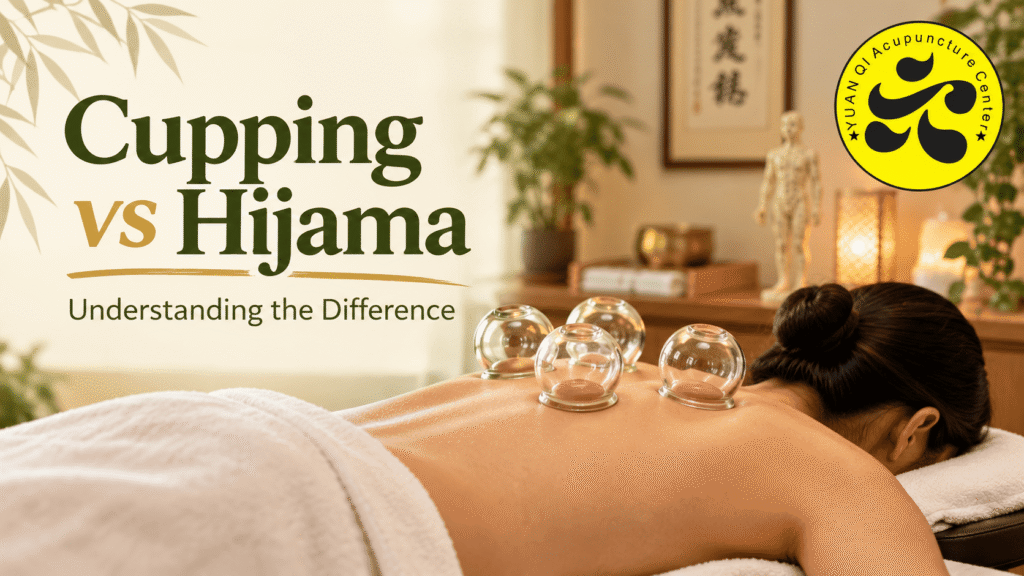
Cupping is one of the oldest hands-on therapies there is, and versions of it appear in Chinese, Middle Eastern, Greek and European traditional medicine. Glass, plastic or silicone cups are placed on the skin and a vacuum is created, either with a hand pump or, traditionally, with a brief flame inside a glass cup. The suction lifts the skin and the tissue just beneath it.
In Traditional Chinese Medicine, cupping is used to move Qi and blood where they are thought to have become stuck, which is described as stagnation. In plainer terms, people use it to ease tight, aching muscles and to help them relax. The cups may be left in one place for several minutes, or oiled and slid across the back, which is called moving or gliding cupping.
At our clinic, cupping is rarely used on its own. It is most often added to an acupuncture or Tui Na session for neck, shoulder and back tension, or for people who simply carry a lot of stress in their upper body.
What is Hijama?
Hijama is the Arabic name for wet cupping. The word comes from a root meaning to draw or suck. It has a long history in the Middle East and holds particular significance for many Muslims because it is mentioned in the hadith as a recommended practice, which is one reason it is so widely sought in the UAE.
A typical Hijama session at a clinic goes like this:
- A short assessment and health check, including questions about medication, bleeding and pregnancy
- The skin is cleaned and dry cups are applied for a few minutes
- The cups are removed and a few shallow cuts are made with a sterile single-use blade
- The cups are reapplied so a small amount of blood collects in them
- The cups are removed, the skin is cleaned, and the areas are dressed
The cuts are superficial, in the very top layer of skin, and are designed to heal quickly. Everything that touches the skin or blood should be single use and opened in front of you.
Is Hijama the same as wet cupping?
Yes. Hijama and wet cupping describe the same technique. Hijama is the term used in Arabic and in Islamic medicine; wet cupping is the general English term. Chinese medicine also has a version, sometimes called bleeding cupping, used in specific situations. Whatever it is called, the defining feature is the same: the skin is lightly cut and a small amount of blood is drawn.
Does Hijama hurt more than cupping?
A little, yes. Dry cupping feels like a strong, deep pull on the skin. Most people find it comfortable, and some find it very relaxing. Stronger suction or moving cupping over tight muscles can feel intense for a moment, but it should never be sharply painful.
Hijama adds the cuts. Most people describe them as a quick sting or scratch rather than real pain, and they are over in seconds. The skin can feel tender for a day or two afterwards, similar to a light graze.
Cupping vs Hijama: which one should you choose?
It depends on what you want from the treatment and on your health. As a rough guide:
- If you want relief from muscle tightness, or a relaxing addition to acupuncture or massage, dry cupping is usually the place to start.
- If Hijama matters to you for religious or traditional reasons, and you are in good health, wet cupping at a licensed clinic is the appropriate way to have it.
- If you are pregnant, anaemic, on blood thinners or have recently given blood, dry cupping may still be possible after assessment, but Hijama is generally not suitable.
- If you are nervous about blood or needles, dry cupping gives you the cups without the cuts.
Your practitioner should go through this with you at the start and tell you plainly if one option is not right for you.
What are cupping and Hijama used for?
Most people come to us for cupping or Hijama because of muscle tension and aches in the neck, shoulders and back, often from long hours at a desk, driving or training. Others use it as part of a regular routine for relaxation, or for religious and traditional reasons in the case of Hijama.
It is worth being honest about the evidence. Research on cupping is growing but mixed, and many of the studies are small. There is some support for its use in muscle and back pain, but little reliable evidence for many of the broader claims made online. We use it as complementary care alongside a proper assessment, and alongside medical treatment where that is needed.
Does Hijama remove toxins from the body?
This is one of the most common claims, and we do not make it. Your liver and kidneys are the organs that clear waste from the body, and there is no good scientific evidence that drawing small amounts of blood through the skin detoxifies you. If you are offered Hijama with promises of removing toxins or ‘bad blood’, or curing a long list of diseases, treat that as a warning sign about the provider rather than a reason to book.
Is Hijama safe? Who should avoid it?
Both treatments are generally safe when done by a trained practitioner in a clean, licensed setting with sterile, single-use equipment. Hijama carries more risk than dry cupping because the skin is broken, so the main concerns are infection, bleeding and fainting, which is why the setting and the screening matter.
UAE health authorities have said that children, pregnant women, elderly people, people with anaemia or a fever, and anyone who has recently given blood should avoid cupping treatment. In practice, the list we screen for before Hijama also includes:
- Blood-thinning medication or a bleeding disorder
- Diabetes, particularly if wound healing is slow
- A pacemaker or other implanted device near the treatment area
- Broken, inflamed or infected skin, or skin conditions on the treatment area
- Feeling unwell, very tired, dehydrated or having not eaten
- A history of fainting during blood tests or injections
None of this is meant to put you off. It is simply what a responsible clinic checks before breaking the skin.
Is home Hijama allowed in Dubai?
No. UAE health authorities require cupping, and Hijama in particular, to take place in a licensed medical centre under supervision, and they have warned residents against having it done at home. At Yuan Qi, Hijama is carried out only at our clinic in Business Bay, never as a home visit.
What do the marks mean, and how long do they last?
Cupping marks are the round, red to purple circles left where the cups sat. They come from small blood vessels under the skin breaking under the suction, much like a bruise, although they are usually painless. They typically fade over several days to around a week or two, depending on the strength of the suction and how your skin heals.
You will sometimes hear that darker marks mean more ‘toxins’ or more stagnation. In Chinese medicine, the colour of the marks is read as part of the picture, but darker marks do not mean anything poisonous is leaving the body. If you have an event coming up, such as a wedding, a beach holiday or a photo shoot, tell us and we will plan around it.
Hijama aftercare: what to do after your session
Aftercare for dry cupping is simple: keep the area warm and covered, drink water, and avoid very hot showers, saunas and hard exercise for the rest of the day. Hijama needs a little more care because the skin has been cut:
- Keep the cut areas clean and dry for the first day, and follow the dressing advice you are given
- Shower with lukewarm water rather than hot, and pat the skin dry
- Avoid swimming pools, the sea, saunas, steam rooms and the gym until the cuts have healed, usually a few days
- Avoid heavy lifting or anything that stretches the treated skin hard for the rest of the day
- Eat a proper meal and drink water, especially in the Dubai heat
- Do not pick or scratch the healing cuts
- Contact us, or a doctor, if you notice increasing redness, heat, swelling, pus or a fever
What to do before your session
Eat a light meal a couple of hours beforehand rather than coming in on an empty stomach, drink water, and wear a loose top that is easy to remove. Tell us about all medication and supplements you take.
Hijama Sunnah days and timing
Many Muslim patients prefer to have Hijama on the Sunnah days, traditionally the 17th, 19th and 21st of the Islamic lunar month, and some prefer particular days of the week. This is a matter of religious practice rather than medical advice, and we are happy to schedule around it. If you would like your appointment on one of these days, mention it when you book, as these dates tend to fill quickly.
Medically, the most important timing points are simpler: avoid Hijama when you are unwell, dehydrated or very tired, and leave a sensible gap after giving blood.
How often can you have cupping or Hijama?
Dry cupping can be repeated fairly often once the marks have faded, and as part of a course for muscle tension it may be done weekly. Hijama is done far less frequently because the skin needs to heal and blood is drawn each time. Many people have it occasionally rather than as a regular weekly treatment. Your practitioner should agree a sensible interval with you based on your health.
Cupping and Hijama at Yuan Qi
At Yuan Qi, both dry cupping and Hijama are offered as part of Traditional Chinese Medicine care, in private treatment rooms at our licensed clinic on Sheikh Zayed Road in Business Bay. Every treatment starts with an assessment and a health check. Hijama is only carried out after that screening, with sterile single-use blades and cups, and only at the clinic.
Cupping is often combined with acupuncture, moxibustion or Tui Na massage in the same visit. We will explain why we are suggesting it, and what it costs, before adding anything. No referral is needed.
The short version
- Cupping vs Hijama comes down to one step: Hijama adds small superficial cuts, so a little blood is drawn.
- Dry cupping is gentler, needs little aftercare and suits more people.
- Hijama has more contraindications and needs clean wound care for a few days.
- In the UAE, Hijama should only be done in a licensed medical centre, not at home.
- Neither treatment removes toxins. Both are complementary care for comfort and relaxation, not a cure.
- Sunnah timing is a religious preference the clinic can accommodate.
FAQs
- What is the difference between cupping and Hijama?
Hijama is a form of cupping. In dry cupping, the cups create suction on unbroken skin. In Hijama, small superficial cuts are made after the first round of cups, and the cups are reapplied so a small amount of blood is drawn.
- Cupping vs Hijama: which is better?
Neither is better for everyone. Dry cupping is gentler and suits more people, especially for muscle tension. Hijama is often chosen for religious or traditional reasons, but it has more restrictions and needs more aftercare.
- Is Hijama the same as wet cupping?
Yes. Hijama is the Arabic and Islamic medicine term, and wet cupping is the general English term for the same technique.
- Does Hijama hurt?
Most people feel the cuts as a quick sting or scratch that is over in seconds. The suction feels like a strong pull. The skin may feel tender for a day or two afterwards.
- Does dry cupping hurt?
Usually not. It feels like a firm, deep pull on the skin, and many people find it relaxing. Stronger or moving cupping over tight muscles can feel intense briefly, but it should not be sharply painful.
- How long do cupping marks last?
Usually several days to around a week or two, depending on the suction strength and your skin. Tell your practitioner if you have an event coming up so they can plan around it.
- Do darker cupping marks mean more toxins?
No. The marks come from small blood vessels under the skin reacting to suction, much like a bruise. Their colour does not mean toxins are leaving the body.
- Does Hijama detox the body?
There is no good scientific evidence that Hijama removes toxins. The liver and kidneys clear waste from the body. We offer Hijama as complementary care, not as a detox.
- Who should not have Hijama?
People who are pregnant, anaemic, on blood thinners, have a bleeding disorder, have recently given blood, are unwell or have a fever, and children. Diabetes and some skin conditions also need assessment first.
- Can I have Hijama at home in Dubai?
No. UAE health authorities require cupping and Hijama to be carried out in a licensed medical centre under supervision, and have warned against home Hijama. Yuan Qi only performs Hijama at the clinic.
- Is Hijama safe?
It is generally safe when done by a trained practitioner in a licensed clinic with sterile single-use equipment and proper screening. The main risks are infection, bleeding and fainting, which is why the setting matters.
- What should I do after Hijama?
Keep the cut areas clean and dry, shower with lukewarm water, avoid pools, the sea, saunas and the gym until healed, eat and drink well, and contact a doctor if you notice signs of infection.
- Can I shower after cupping?
Yes, but use lukewarm rather than hot water and avoid saunas or steam rooms that day. After Hijama, follow the dressing advice and pat the skin dry gently.
- Can I go to the gym after Hijama?
It is best to avoid the gym and heavy exercise until the small cuts have healed, usually a few days, so the skin is not stretched or exposed to sweat and equipment.
- Should I eat before Hijama?
Yes. Have a light meal a couple of hours beforehand and drink water. Coming in on an empty stomach makes feeling faint more likely.
- What are the Sunnah days for Hijama?
Traditionally the 17th, 19th and 21st of the Islamic lunar month. This is a religious preference rather than medical advice, and Yuan Qi can schedule your appointment on these days if you ask when booking.
- How often can I have Hijama?
Much less often than dry cupping, because the skin needs to heal and blood is drawn each time. Many people have it occasionally. Your practitioner should agree a sensible interval with you.
- Can cupping be combined with acupuncture?
Yes. At Yuan Qi, cupping is often added to acupuncture, moxibustion or Tui Na massage in the same session. We explain why and what it costs before adding it.
- Can I have cupping during pregnancy?
Hijama is not suitable during pregnancy. Gentle dry cupping may sometimes be possible on certain areas after assessment, so always tell your practitioner if you are or might be pregnant.
- How do I book cupping or Hijama at Yuan Qi?
Call or WhatsApp us on +971 50 288 4479 or book through our website. Tell us if you would like Hijama on a Sunnah day so we can arrange it.