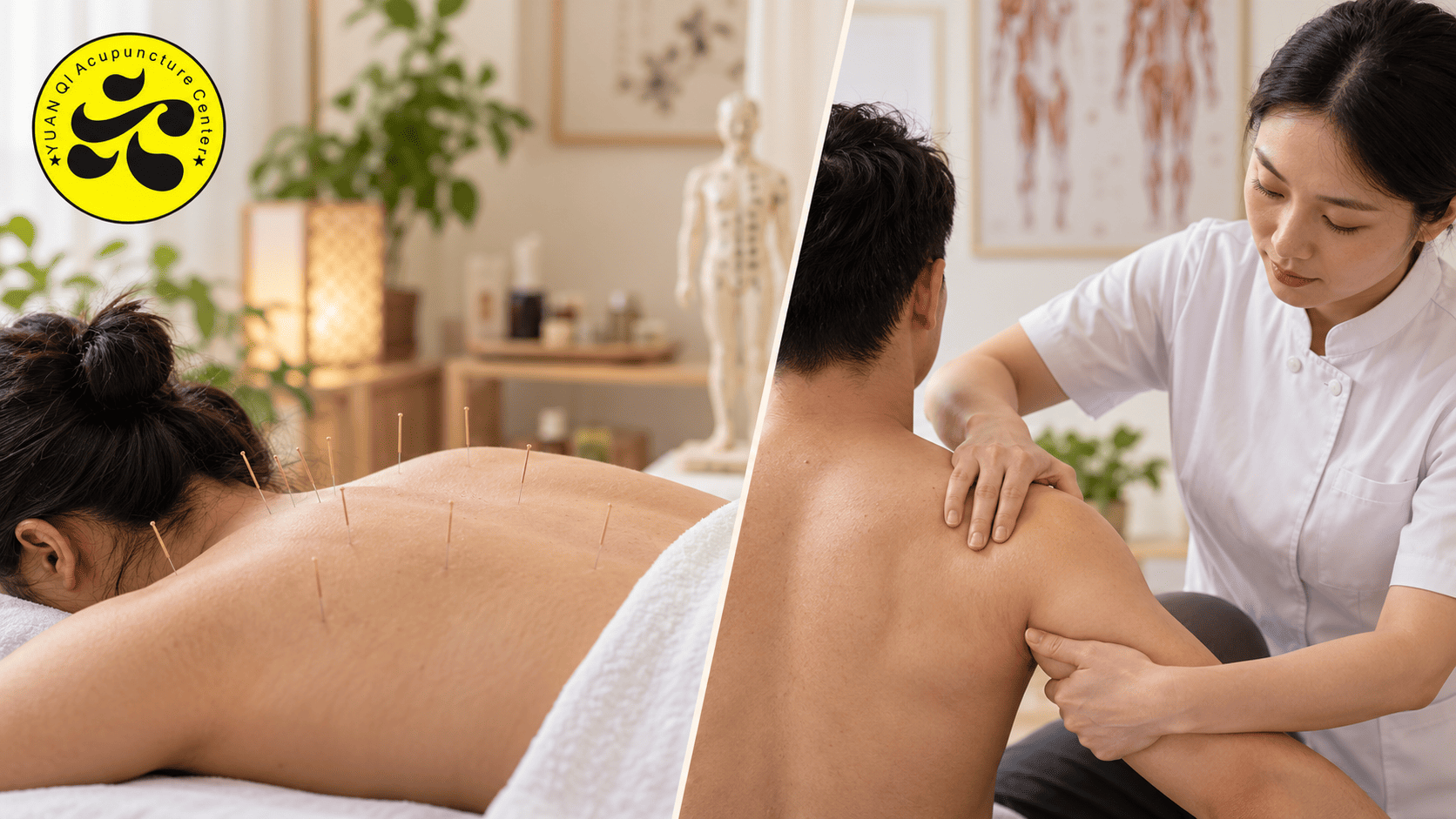
If you have been told you need dry needling and wondered whether it is just acupuncture under another name, you are not alone. The question of dry needling vs acupuncture comes up at our clinic in Business Bay almost every week, usually from people who have seen both on a price list and cannot tell them apart. That is fair. From the outside they look identical: a fine needle, a treatment table, and a practitioner who knows where to put it.
We are in a slightly unusual position to answer it, because we offer both. Acupuncture at Yuan Qi is led by Dr. Jun Huang, a doctor of Traditional Chinese Medicine licensed by the Dubai Health Authority and the Ministry of Health. Dry needling is carried out by our physiotherapist, Dr. SuryaLakshmi, who is certified in clinical dry needling. So this is not one side explaining the other. It is two practitioners who work down the corridor from each other and regularly share patients.
What is the difference between dry needling and acupuncture?
The difference between dry needling and acupuncture is the reasoning behind where the needle goes, not the needle itself. Dry needling follows a Western musculoskeletal model: find the tight, tender band in the muscle that is driving the pain and needle it directly. Acupuncture follows a Traditional Chinese Medicine model: assess the whole pattern behind the symptoms, then choose points along the body’s channels, some of which may be nowhere near the sore spot.
Here is how the two compare side by side.
| Dry needling | Acupuncture | |
| Where it comes from | Western medicine and physiotherapy, built on trigger point research | Traditional Chinese Medicine, practised for centuries |
| Main aim | Release a specific tight or irritable muscle | Restore balance in the body as a whole and ease symptoms |
| How points are chosen | By feeling for trigger points in the muscle | By a TCM assessment that includes your history, tongue and pulse |
| How long the needles stay in | Seconds to a few minutes, often moved in and out | Usually around 20 to 30 minutes while you rest |
| What it tends to feel like | Deeper, more muscular, sometimes a brief twitch | Subtle, often a dull ache, warmth or heaviness |
| Typically used for | Muscle pain, stiffness, sports and desk-related strain | Pain, plus stress, sleep, headaches, digestion and women’s health |
| Who does it at Yuan Qi | Dr. SuryaLakshmi, physiotherapist | Dr. Jun Huang, doctor of TCM |
| Often paired with | Exercise, manual therapy and rehab | Cupping, moxibustion, Tui Na and herbal medicine |
What is dry needling?
Dry needling is a physiotherapy technique in which a fine, solid needle is inserted into a trigger point, the small, tight knot you can sometimes feel when someone presses into a sore shoulder or the side of your neck. The word ‘dry’ simply means nothing is injected. The needle itself is the treatment.
It grew out of research into muscle trigger points in the second half of the twentieth century, when doctors noticed that needling a knot, even without injecting anything into it, could ease the pain it was causing. Physiotherapists have since refined it into a precise, targeted technique.
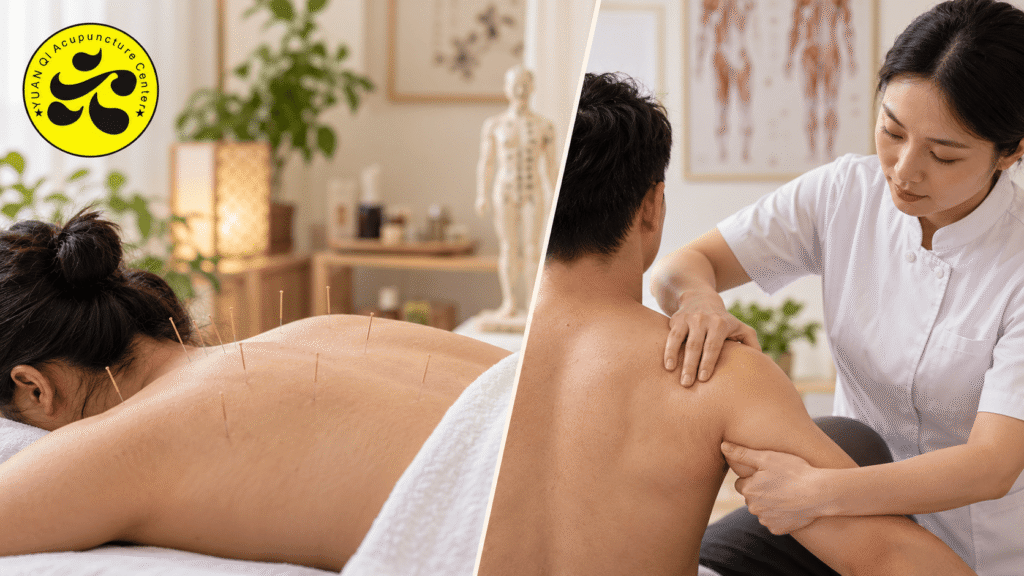
In a session, the physiotherapist feels along the muscle to find the band that reproduces your pain, then inserts the needle into it. The needle may be moved gently in and out for a short time. Often the muscle gives a quick involuntary twitch, called a local twitch response, which is usually a sign the right spot has been found. Then the needle comes out, and the area is often followed by stretching or exercise.
Dry needling is almost never a standalone treatment. It is one tool inside a wider physiotherapy plan that also looks at posture, movement and strength, because releasing a knot does not help much if the habit that created it carries on.
What is acupuncture?
Acupuncture is one of the core therapies of Traditional Chinese Medicine. Very fine, sterile needles are placed at specific points on the body to encourage a response from the nervous system and improve circulation. In Chinese medicine terms, the aim is to restore the smooth flow of Qi and blood through channels known as meridians. In plain clinical language, the needles prompt the body to calm an overactive stress response and release its own pain-relieving chemicals.
The biggest practical difference is the assessment. Before any needle goes in, a TCM practitioner asks about far more than the sore spot: your sleep, digestion, stress, energy and, where relevant, your menstrual cycle. They usually look at your tongue and feel your pulse. Two people with the same lower back pain can end up with quite different treatments, because the pattern behind the pain is different.
Once the needles are in place, you rest with them for around twenty to thirty minutes. Many people find it deeply relaxing and some fall asleep on the table. Acupuncture can also be combined with electrical stimulation, known as electro-acupuncture, or with cupping, moxibustion and Tui Na massage in the same visit.
Is dry needling the same as acupuncture?
No, although the two overlap more than either side sometimes likes to admit. They use the same type of needle, and many classic acupuncture points sit very close to common trigger points. Some acupuncturists argue that dry needling is simply a narrow form of acupuncture. Many physiotherapists argue it is a separate technique with its own logic and training.
For you as a patient, the more useful way to think about it is this: dry needling is a technique, while acupuncture is part of a whole system of medicine. Dry needling asks ‘which muscle is causing this?’ Acupuncture asks ‘why is this happening in this person?’ Both are valid questions. Which one matters more depends on what you are dealing with.
Does dry needling hurt more than acupuncture?
Usually, dry needling feels stronger than acupuncture. Because the needle goes into a tight, sensitive part of the muscle, and because it may be moved to provoke a twitch, people often describe a deep cramp-like ache for a second or two. It passes quickly, but it is not subtle.
Acupuncture tends to feel gentler. Most people notice a small pinch as the needle goes in, then a dull ache, warmth or heaviness around the point, which Chinese medicine regards as a good sign that the point is active. After that, most of the session is spent lying still.
Afterwards, dry needling commonly leaves the treated muscle feeling sore or bruised for a day or two, a bit like the morning after a hard workout. Acupuncture more often leaves people feeling relaxed or a little tired. Both are normal and both settle on their own.
Which is better for back pain, neck pain and sports injuries?
It depends on where the pain is coming from and how long you have had it. Neither is better across the board, and anyone who tells you otherwise is selling one of them.
Dry needling often suits pain that is clearly muscular and local:
- A tight upper back and neck from long hours at a laptop
- A knot under the shoulder blade that refers pain up into the head
- Calf, hamstring or glute tightness from running or gym work
- A muscle that has guarded and stiffened after an injury and needs releasing before rehab can progress
Acupuncture often suits pain that is longer-standing or more tangled up with the rest of your life:
- Back or neck pain that keeps returning even after physiotherapy
- Pain that is worse when you are stressed or sleeping badly
- Sciatica-type pain or pain that spreads over a wide area
- Joint pain, headaches or jaw pain alongside muscle tension
In practice, a lot of the back and neck pain we see in Dubai has both elements: a genuinely tight muscle and a nervous system that has been running on stress for months. That is where combining the two tends to make the most sense.
When is acupuncture the better fit?
Dry needling is designed for muscles. Acupuncture has a much wider scope, so if your main concern is not muscular, acupuncture is the relevant option. People come to us for acupuncture as complementary support for stress and anxiety, poor sleep, migraines and tension headaches, digestive discomfort, fatigue, and women’s health concerns such as painful or irregular periods.
It is always used alongside conventional medical care, not instead of it. If something needs investigating, such as a new or unexplained symptom, the right first step is your doctor.
Can you have dry needling and acupuncture together?
Yes, and for some people that is the most practical approach. A common pattern at our clinic is a patient who arrives with stubborn neck and shoulder pain from desk work. Dr. SuryaLakshmi assesses the muscles, uses dry needling on the trigger points that are clearly driving the pain, and builds a rehab plan. Dr. Jun Huang then looks at why the tension keeps coming back, which is often stress and broken sleep, and treats that side of it with acupuncture.
The two are not always done in the same session. Depending on how sore the muscle is after dry needling, they may be spaced a few days apart. The point is that the plan is joined up, with both practitioners aware of what the other is doing.
Are there side effects or risks?
Both treatments are considered safe when carried out by a trained, licensed practitioner using sterile, single-use needles. The common side effects are minor and short-lived:
- Soreness or a bruised feeling at the needle site, more likely after dry needling
- Small bruises or a tiny spot of bleeding
- Feeling tired, light-headed or emotional after a session
- Occasionally, a brief flare in symptoms before they settle
Serious problems are rare. The most important one to know about is that needling over the chest wall or upper back carries a small risk of puncturing the lung if it is done carelessly. This is exactly why training, anatomy knowledge and licensing matter more than price. Ask who will be treating you and what qualifies them to do it.
Tell your practitioner first if any of these apply
- You are pregnant or might be
- You take blood thinners or have a bleeding disorder
- You have a pacemaker or other implanted device, especially before any electrical stimulation
- You have diabetes, a weakened immune system or skin problems near the treatment area
- You have fainted during injections or blood tests before
- You have a metal allergy
None of these automatically rules you out. They simply change how the treatment is planned.
Who performs each treatment in Dubai?
This is worth checking wherever you go. Acupuncture in Dubai should be carried out by a practitioner licensed by the Dubai Health Authority to practise Traditional Chinese Medicine. Dry needling is usually performed by a physiotherapist who has completed additional, certified training in the technique.
At Yuan Qi, acupuncture is led by Dr. Jun Huang, who holds a bachelor’s and master’s degree in acupuncture from Guangxi Traditional Chinese Medical University and has practised in the UAE since 2013. Dry needling is carried out by Dr. SuryaLakshmi, our physiotherapist, who is certified in clinical dry needling and rehabilitation. You will always know which of them is treating you and why.
Dry needling vs acupuncture: how do I choose?
If you are still unsure, these questions usually point the right way:
- Is the pain in one muscle you can put your finger on? Dry needling is a reasonable place to start.
- Has the pain been coming and going for months, or does it get worse with stress? Acupuncture, or both, is worth considering.
- Is your main concern sleep, stress, headaches, digestion or your cycle? Acupuncture is the relevant option.
- Are you recovering from an injury and need to rebuild strength? Physiotherapy with dry needling as part of it.
- Do you dislike strong sensations? Acupuncture is generally the gentler experience.
You do not have to work this out alone. Tell us what is going on when you get in touch, and we will tell you honestly which practitioner you should see first.
What happens when you book at Yuan Qi?
Your first visit starts with an assessment, not a needle. If you are seeing Dr. SuryaLakshmi, that means a physiotherapy assessment of how you move, where the tightness is and what is loading it. If you are seeing Dr. Jun Huang, it means a TCM consultation covering your history, sleep, stress and digestion, with a tongue and pulse check. Either way, you will hear what we think is going on and what we suggest before treatment begins, along with a realistic idea of how many sessions it is likely to take.
The clinic is in the Sheikh Majid Building on Sheikh Zayed Road in Business Bay, easy to reach from Downtown, Al Wasl, Jumeirah and DIFC. No referral is needed, and we can provide receipts and treatment summaries if your insurance covers acupuncture or physiotherapy.
The short version
- Dry needling vs acupuncture comes down to reasoning, not needles: the needles are the same.
- Dry needling targets trigger points in a specific muscle and is part of physiotherapy.
- Acupuncture is part of Traditional Chinese Medicine and looks at the whole pattern behind your symptoms.
- Dry needling usually feels stronger; acupuncture is usually gentler and more relaxing.
- Many people do best with a combination, planned by practitioners who talk to each other.
- Both are complementary care and work alongside your doctor, not instead of them.
FAQs
- What is the main difference between dry needling and acupuncture?
The reasoning behind where the needle goes. Dry needling targets tight trigger points in a specific muscle, based on Western physiotherapy. Acupuncture uses points chosen through a Traditional Chinese Medicine assessment and looks at the whole pattern behind your symptoms.
- Dry needling vs acupuncture: which is better?
Neither is better in every case. Dry needling often suits clearly muscular, local pain. Acupuncture often suits longer-standing pain or pain mixed with stress and poor sleep, and it is also used for non-muscular concerns. Many people benefit from both.
- Is dry needling the same as acupuncture?
No. They use the same type of thin, solid needle, but dry needling is a single physiotherapy technique aimed at muscles, while acupuncture is part of the wider system of Traditional Chinese Medicine.
- Do dry needling and acupuncture use the same needles?
Yes, both use fine, solid, sterile single-use needles. Nothing is injected in either treatment. The difference is in where the needles go, how long they stay in and how they are used.
- Does dry needling hurt?
It usually feels stronger than acupuncture. Many people feel a brief, deep cramp or a small muscle twitch when the trigger point is reached. It passes in seconds, though the muscle may feel sore for a day or two afterwards.
- Does acupuncture hurt?
Most people feel very little. There may be a small pinch as the needle goes in and then a dull ache, warmth or heaviness around the point. Many patients find the session relaxing enough to fall asleep.
- How long does each treatment take?
Dry needling is usually part of a physiotherapy session, with the needles in for seconds to a few minutes. In acupuncture the needles typically stay in for around 20 to 30 minutes. A first visit for either takes longer because it includes an assessment.
- Which is better for back pain?
It depends on the cause. A tight, local muscle may respond well to dry needling as part of physiotherapy. Back pain that keeps returning, spreads widely or worsens with stress often suits acupuncture or a combined plan.
- Which is better for neck and shoulder pain from desk work?
Desk-related neck and shoulder pain is often a mix of tight muscles and ongoing stress. Dry needling can release the trigger points, while acupuncture can help with the tension and poor sleep that keep bringing it back.
- Can dry needling help with stress, sleep or headaches?
Dry needling is designed for muscles, so it is not used for stress or sleep. It can help headaches that are driven by tight neck and shoulder muscles. For stress, sleep and most other headaches, acupuncture is the relevant option.
- Can I have dry needling and acupuncture together?
Yes. At Yuan Qi our physiotherapist and TCM doctor often share patients. Depending on how sore the muscle is, the treatments may be done on the same day or spaced a few days apart.
- What are the side effects of dry needling?
The most common is muscle soreness for a day or two, along with possible bruising, tiredness or light-headedness. Serious problems are rare when it is done by a trained, certified practitioner.
- What are the side effects of acupuncture?
Side effects are usually minor: slight bruising, a small spot of bleeding, or feeling tired or relaxed afterwards. Serious problems are rare when a licensed practitioner uses sterile, single-use needles.
- Is dry needling safe during pregnancy?
Always tell your practitioner if you are pregnant or might be. Some points and areas are avoided in pregnancy, and the treatment plan will be adapted or changed accordingly.
- Can I have needling if I take blood thinners?
Often yes, but you must tell your practitioner first. Blood thinners increase the chance of bruising, so the approach may be adjusted.
- Who can perform dry needling and acupuncture in Dubai?
Acupuncture should be carried out by a practitioner licensed by the Dubai Health Authority to practise Traditional Chinese Medicine. Dry needling is usually performed by a physiotherapist with additional certified training. Always ask who is treating you.
- How many sessions will I need?
It depends on the problem and how long you have had it. Recent muscular pain may settle in a few sessions. Long-standing or recurring problems usually need a longer course. You will get a realistic plan after your first assessment.
- What is electro-acupuncture, and is it the same as dry needling with stimulation?
Electro-acupuncture passes a gentle electrical current between acupuncture needles placed at TCM points. Some physiotherapists also add electrical stimulation to dry needling. The equipment is similar, but the point selection and reasoning follow the two different approaches.
- Is dry needling or acupuncture covered by insurance in the UAE?
It depends entirely on your policy. Some plans cover physiotherapy, some cover acupuncture, and some cover neither. Check with your insurer first; we can provide receipts and treatment summaries for claims.
- Do I need a referral to book at Yuan Qi?
No. You can book directly by phone or WhatsApp on +971 50 288 4479 or through our website, and your first visit starts with an assessment.
Book Appointment :
Yuan Qi Acupuncture center – https://yuanqiacupuncture.com/
Call or WhatsApp us on +971 50 288 4479, or book an assessment online, and we will point you to the right practitioner.