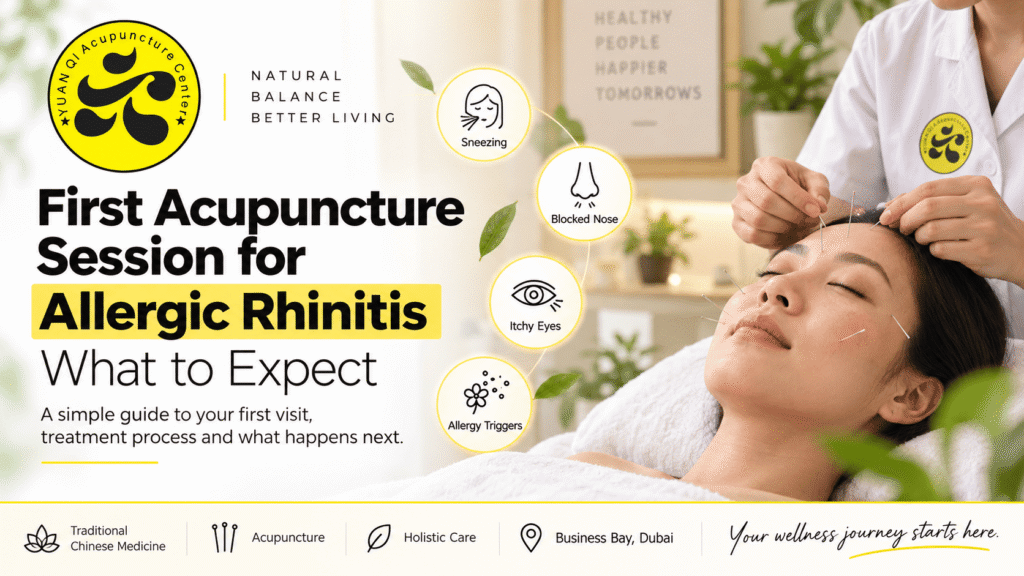
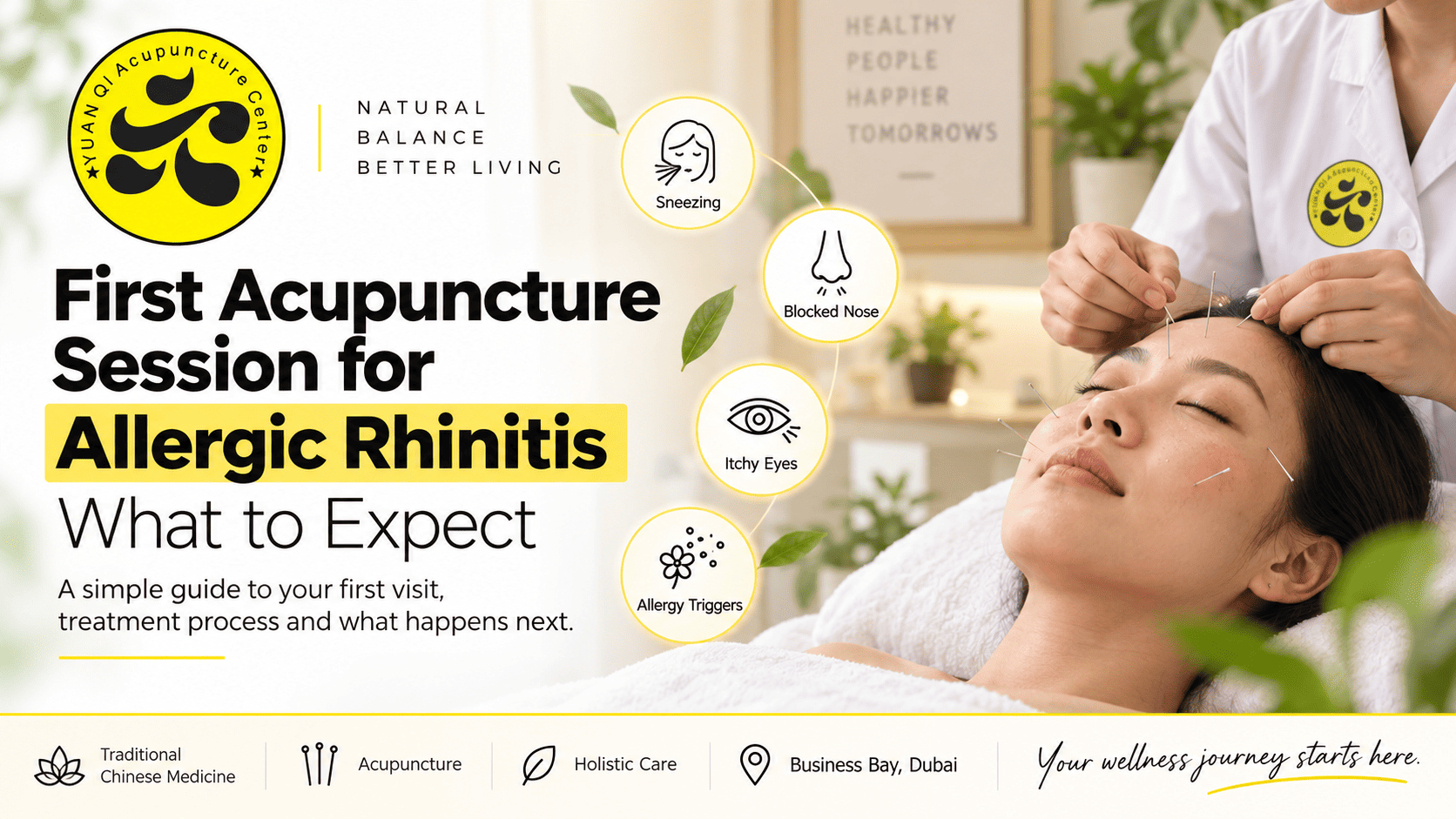
Sneezing several times before you’ve even finished breakfast. A blocked nose that seems to return every morning. Itchy eyes. A runny nose. Poor sleep because you cannot breathe comfortably.
For someone living with allergic rhinitis, these symptoms can become part of everyday life.
You may already know which things tend to trigger your symptoms — dust, pollen, pets or changes in the environment. You may also be using antihistamines, nasal sprays or other treatments to keep them under control.
At some point, you might start wondering whether acupuncture could be another option worth exploring.
And if you have never tried acupuncture before, the next question is usually:
What actually happens during the first session?
The first appointment is generally much more about understanding you than simply placing needles.
Here is what you can expect.
First, What Exactly Is Allergic Rhinitis?
Allergic rhinitis occurs when the inside of the nose reacts to something you are allergic to.
Common triggers include:
- pollen
- house dust mites
- animal dander
- mould
- certain workplace allergens
Typical symptoms include sneezing, an itchy nose, a blocked or runny nose and itchy or watery eyes. Symptoms may appear only during certain times of the year or continue throughout the year depending on the trigger.
Some people also find that their sleep, concentration or daily routine is affected when symptoms become persistent.
Acupuncture does not replace proper allergy diagnosis or conventional treatment, but some adults explore it as a complementary option for managing symptoms.
Your First Appointment Starts With a Conversation
Do not expect to walk into the treatment room and immediately have needles inserted.
A good first acupuncture appointment should begin with a proper consultation.
Your practitioner will want to understand what has actually been happening.
You may be asked questions such as:
- When did your allergy symptoms begin?
- Are they present throughout the year or only seasonally?
- What usually triggers them?
- Is congestion your main problem, or is it sneezing and itching?
- Are your eyes affected?
- Do symptoms interfere with your sleep?
- Are you taking antihistamines or using nasal sprays?
- Have you had allergy testing?
- Do you have asthma, eczema or other allergies?
- Are there other health concerns or medications your practitioner should know about?
These questions are not just small talk.
Two people can both have allergic rhinitis and still experience it very differently.
One person may wake every morning with a blocked nose. Another may be fine most of the year but struggle badly during a particular season.
The treatment approach should reflect those differences.
Your Practitioner May Also Ask About Things That Seem Unrelated
This sometimes surprises people during their first Traditional Chinese Medicine consultation.
You may be asked about:
- sleep
- digestion
- energy levels
- stress
- appetite
- general health
- previous illnesses
From a Traditional Chinese Medicine perspective, practitioners do not only look at one isolated symptom.
They consider the broader pattern of the person’s health before choosing acupuncture points.
Depending on the practitioner, the consultation may also include traditional observations such as checking the tongue and pulse.
You do not need to understand all of this beforehand.
Your practitioner should explain what they are doing and why.
Will the Acupuncturist Confirm That You Have an Allergy?
This distinction is important.
An acupuncture consultation is not the same thing as formal allergy testing.
If you are not sure whether your symptoms are actually caused by an allergy, or if your symptoms are severe or persistent, you may need assessment by an appropriate medical professional.
Allergic rhinitis can sometimes resemble other forms of rhinitis, and identifying the cause matters.
If required, conventional allergy assessment can involve medical history, skin-prick testing or blood tests.
A responsible acupuncture practitioner should not discourage you from seeking medical investigation when it is appropriate.
What Happens Once the Consultation Is Finished?
If acupuncture is considered suitable, your practitioner will explain the treatment before starting.
You will normally lie comfortably on a treatment table.
Very fine, sterile, single-use acupuncture needles are inserted into selected points.
The points chosen vary.
They may depend on:
- whether congestion or sneezing is more prominent
- how long symptoms have been present
- whether symptoms are seasonal or year-round
- your general health
- the treatment approach being used
Not every person with allergic rhinitis should automatically receive exactly the same set of acupuncture points.
Personalisation is an important part of the treatment.
Will Needles Be Put Into My Nose?
This is another question people often wonder about.
Standard acupuncture for allergic rhinitis does not necessarily mean needles will be inserted inside the nose.
Some acupuncture points commonly used in practice are located around the face or nose, while others may be elsewhere on the body.
The exact selection depends on the practitioner and treatment plan.
If you are nervous about any particular point, say so before treatment begins.
You should always understand what is being done.
Does Acupuncture Hurt?
Usually, this is the biggest concern before someone’s first appointment.
Acupuncture needles are very fine and are quite different from the hollow needles used for injections.
Some people barely notice insertion.
Others describe:
- a brief pinching feeling
- heaviness
- warmth
- tingling
- a dull sensation around the point
These sensations are usually temporary.
If a needle feels genuinely painful or uncomfortable, tell your practitioner.
You do not need to stay silent because you think discomfort is simply part of the treatment.
How Long Does the First Appointment Take?
The first visit can take longer than follow-up appointments because the practitioner needs time to understand your history.
There may be time spent on:
- consultation
- symptom discussion
- health assessment
- treatment explanation
- acupuncture
- aftercare advice
The exact appointment length varies depending on the clinic and your individual needs.
Rather than focusing too much on the number of minutes, make sure enough time is allowed for your practitioner to understand your symptoms properly.
What Should You Do Before Your Appointment?
You do not need to make complicated preparations.
A few simple things can make the appointment more comfortable.
Eat beforehand
Try not to arrive extremely hungry.
A normal meal or light snack beforehand is usually sensible.
Wear comfortable clothing
Loose clothing makes it easier to access different acupuncture points without unnecessary discomfort.
Bring relevant medical information
If you have had allergy testing, medical reports or a list of medications, having them available can be useful.
Tell the practitioner what you take
Mention any:
- antihistamines
- nasal sprays
- prescription medicines
- supplements
- blood-thinning medication
Do not stop prescribed medication simply because you are starting acupuncture unless the healthcare professional who prescribed it advises you to do so.
Avoid arriving rushed
If possible, give yourself enough time to arrive calmly.
Turning up late and stressed makes the first appointment harder for both you and the practitioner.
What Might You Feel After Acupuncture?
People respond differently.
Some feel relaxed after the session.
Others may feel slightly tired.
Minor temporary effects can include:
- mild soreness
- slight bruising
- a small amount of bleeding at a needle site
- light-headedness
- tiredness
Serious complications from acupuncture are uncommon when it is performed properly by a trained practitioner using sterile equipment.
Your practitioner should explain anything they specifically want you to do after treatment.
Will One Session Stop Your Allergies?
This is where realistic expectations matter.
Probably not.
Allergic rhinitis is an allergic condition, and acupuncture should not be presented as a one-session cure.
Some people may notice changes sooner than others, but individual response varies.
A practitioner may recommend a course of treatment and then review how your symptoms are changing rather than promising a fixed outcome from the beginning.
Be cautious of claims such as:
“Your allergy will disappear after three sessions.”
No responsible healthcare practitioner can guarantee that for every person.
What Does Research Say About Acupuncture for Allergic Rhinitis?
There is some encouraging research, but it should be explained carefully.
The U.S. National Center for Complementary and Integrative Health notes that randomized trials suggest acupuncture may improve some allergic-rhinitis symptoms and quality of life. A previous review involving 13 studies and 2,365 participants found improvements in nasal symptom scores among people receiving acupuncture.
A larger 2022 systematic review involving 30 trials and more than 4,400 participants also found that acupuncture may improve nasal symptoms and quality of life in adults with allergic rhinitis. However, the researchers highlighted weaknesses in the underlying evidence and said additional high-quality trials are still needed.
In other words:
There is evidence suggesting acupuncture may help some adults with allergic-rhinitis symptoms, but it should not be marketed as a guaranteed cure.
That is the approach we believe patients deserve.
Can You Continue Your Allergy Medication?
In many cases, people use acupuncture alongside conventional allergy management.
That may include treatments such as:
- antihistamines
- steroid nasal sprays
- saline nasal rinses
- allergen avoidance
These remain established approaches for allergic rhinitis.
Tell your acupuncturist what medication you are using.
But decisions about changing or stopping medication should be discussed with the relevant doctor or pharmacist rather than made simply because acupuncture has been started.
Complementary care should complement appropriate medical treatment, not automatically replace it.
How Many Acupuncture Sessions Might You Need?
There is no single number that applies to everyone.
Treatment frequency can depend on:
- how severe your symptoms are
- whether they are seasonal or year-round
- how long you have had them
- your exposure to triggers
- your overall health
- how you respond to treatment
Instead of deciding beforehand that everybody needs six, eight or ten sessions, progress should be reviewed along the way.
Your practitioner should be able to explain why they are recommending a particular schedule.
What Can You Do Outside the Treatment Room?
Acupuncture is only one possible part of managing allergic rhinitis.
Knowing and reducing exposure to your triggers can be just as important.
Depending on your allergy, practical measures may include:
- reducing exposure to dust mites
- keeping the home well ventilated
- dealing with damp or mould
- washing bedding regularly
- using appropriate cleaning methods
- reducing exposure to pets when relevant
- limiting pollen exposure when levels are high
The right approach depends on what actually triggers your symptoms.
If you have never established the cause of persistent symptoms, consider discussing allergy assessment with an appropriate healthcare professional.
When Should You See a Doctor?
Acupuncture should not delay conventional medical assessment.
Speak with a healthcare professional if:
- you are not sure what is causing your symptoms
- your symptoms are getting worse
- symptoms are significantly affecting sleep or daily life
- pharmacy treatment is not helping
- you also have asthma and it is worsening
Severe allergic reactions are different from ordinary allergic rhinitis and may require urgent medical care.
Choosing an Acupuncture Clinic for Allergic Rhinitis in Dubai
If you are thinking about acupuncture, look at the practitioner rather than simply looking at advertising claims.
Ask:
- Is the practitioner appropriately licensed?
- What is their professional training?
- Will they take a proper health history?
- Are sterile, single-use needles used?
- Will the treatment be personalised?
- Will they explain realistic expectations?
- Will they tell you when medical assessment is more appropriate?
You should feel comfortable asking questions before treatment begins.
Your First Allergy Acupuncture Consultation at Yuan Qi
At Yuan Qi Acupuncture Center in Business Bay, Dubai, the first step is a consultation.
The clinic is led by Dr. Jun Huang, who holds bachelor’s and master’s qualifications in acupuncture and is licensed by the Dubai Health Authority and Ministry of Health. Yuan Qi provides acupuncture and Traditional Chinese Medicine alongside other complementary services from its Business Bay clinic.
If you are dealing with recurring sneezing, nasal congestion or other allergy-related symptoms and would like to learn more, visit our dedicated Acupuncture for Allergic Rhinitis (Sinus Allergy) page.
There you can learn more about how Yuan Qi approaches allergic-rhinitis consultations and treatment.
Frequently Asked Questions
Can acupuncture cure allergic rhinitis permanently?
There is currently no basis for promising that acupuncture will permanently cure allergic rhinitis.
Research suggests it may help reduce symptoms for some adults, but responses vary and further research is still needed.
Can acupuncture help a blocked nose caused by allergies?
Some clinical research has reported improvements in nasal symptom scores in adults receiving acupuncture for allergic rhinitis. However, improvement cannot be guaranteed for an individual patient.
Do I need to stop antihistamines before acupuncture?
Do not stop medication simply because you are having acupuncture.
Tell your practitioner what you are taking and discuss medication changes with the doctor or pharmacist responsible for your treatment.
Can I have acupuncture if my allergies occur all year?
People with both seasonal and perennial allergic rhinitis have been included in acupuncture research.
Whether acupuncture is appropriate for you should be decided after an individual assessment.
Is acupuncture safe?
Acupuncture is generally considered safe when carried out properly by a trained practitioner using sterile, single-use needles, although minor temporary side effects can occur.
Will I feel better after my first session?
Some people may notice changes early, while others may not.
There is no reliable way to promise how quickly an individual person will respond.
Visit Yuan Qi Acupuncture Center in Dubai
If recurring allergy symptoms are affecting your sleep, work or everyday comfort and you would like to explore acupuncture as part of your care, you are welcome to speak with the team at Yuan Qi Acupuncture Center.
Our clinic is located in Business Bay, Dubai, and provides personalised acupuncture and Traditional Chinese Medicine consultations with licensed practitioners.
Yuan Qi Acupuncture Center
📍 M05, Sheikh Majid Building, Sheikh Zayed Road, Business Bay, Dubai, UAE
📞 +971 50 288 4479
For more information about acupuncture for allergic rhinitis or to arrange a consultation, visit Yuan Qi Acupuncture Center or contact our team directly.
Medical Note
This article is for general educational purposes only and is not intended to diagnose, prevent or treat a medical condition. Acupuncture is a complementary healthcare approach and should not delay appropriate medical care.