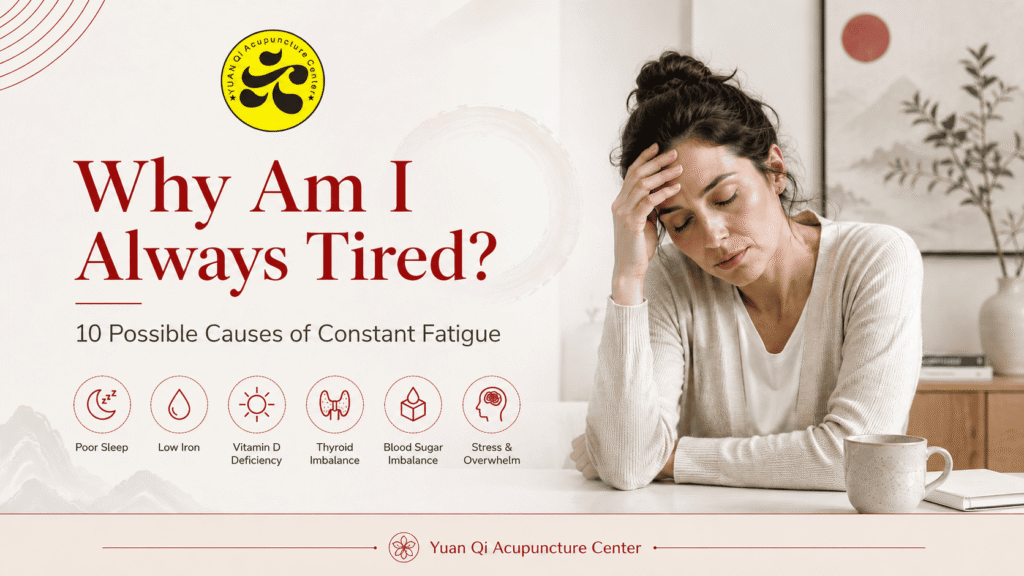
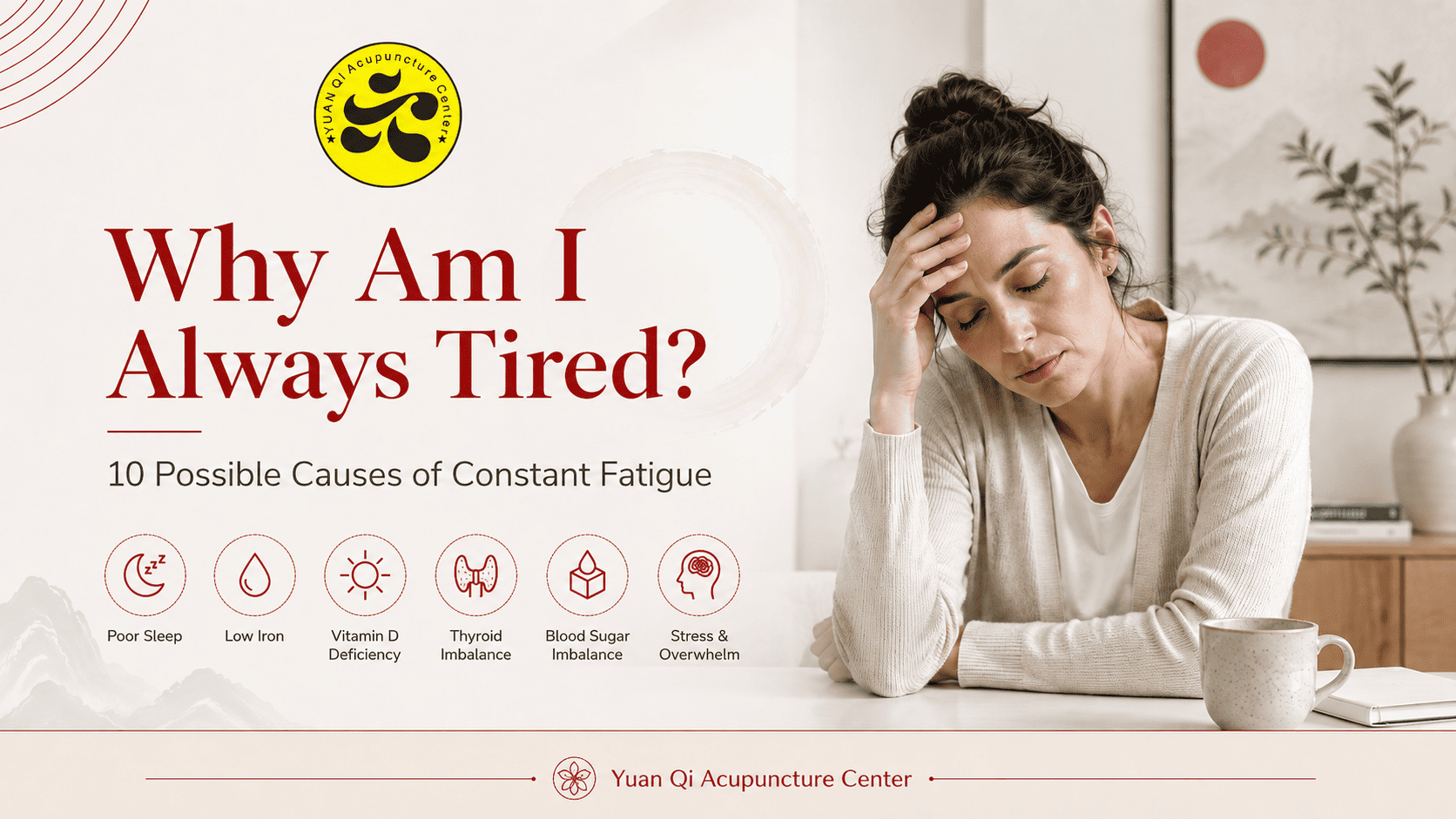
Constant fatigue is tiredness that lasts for weeks or months and does not lift after a full night of sleep or a quiet weekend. It is one of the most common reasons people walk into our clinic in Business Bay, and it almost never comes down to one thing.
If you have been asking yourself why am I always tired, the answer is usually something ordinary that has gone unchecked for too long. Broken sleep. Low iron. A thyroid that has quietly slowed down. Blood sugar swinging up and down all day. Or months of stress your body has never been given a chance to come down from. Below are ten of the most common causes, the tests worth asking your doctor for, and the point at which tiredness stops being a lifestyle problem and starts needing proper medical attention.
Quick answer: tiredness that has lasted more than two to three weeks and does not improve with rest deserves a blood test, not another coffee. Most cases turn out to be sleep quality, iron, vitamin D, thyroid, blood sugar, hormones or stress load, and all of those can be checked.
What counts as being tired all the time?
Being tired all the time means fatigue that lasts for weeks, has no obvious cause you can point to, and does not improve after rest. Normal tiredness is different. It follows a late night or a hard week, and it clears once you catch up.
Constant fatigue tends to look like this:
- Waking up feeling as though you never slept
- Needing caffeine to function rather than to enjoy it
- Brain fog, losing words, rereading the same email
- Heavy limbs, or exercise that suddenly feels much harder than it used to
- Catching every cold going round the office
- Wanting to nap by mid-afternoon most days
If that has been your normal for a month or more, it is worth investigating rather than absorbing.
Why am I always tired even when I sleep eight hours?
Because hours in bed are not the same as hours of restorative sleep, and because sleep is only one of the things your energy depends on. Your body also needs enough iron to carry oxygen around, thyroid hormone to set the pace of your metabolism, steady blood sugar for fuel, and a nervous system that is not stuck in alert mode. If any one of those is off, eight hours will not rescue you.
10 possible causes of constant fatigue
1. Your sleep is long but broken
Snoring, waking with a dry mouth or a headache, getting up twice a night, or a partner who says you stop breathing for a moment. Sleep apnoea is common, frequently missed, and leaves people exhausted no matter how long they spend in bed. It is worth raising with a doctor, who can arrange a sleep study.
The everyday version matters too: scrolling in bed, a heavy dinner at 10pm, a nightcap that knocks you out but stops you reaching deep sleep, or a bedroom the air conditioning keeps at the wrong temperature. Alcohol sedates. It does not restore.
2. Low iron and anaemia
Iron carries oxygen around your body. When it runs low you get tired, breathless on the stairs, cold-handed, pale, and your hair may start shedding more than usual. It is common in women with heavy periods, in vegetarians and vegans, after pregnancy, and in people training hard for endurance events.
One thing worth knowing: you can have depleted iron stores and still have a normal full blood count. Ask for ferritin specifically, not just haemoglobin.
3. Low vitamin D
Most of us here work indoors, drive everywhere, and stay out of the sun for half the year. Low vitamin D shows up as fatigue, aching muscles, low mood and more frequent infections. It is a simple blood test and an easy fix once you know your level. Guessing at a high strength supplement without testing first is not the way to do it.
4. An underactive or overactive thyroid
An underactive thyroid slows everything down: fatigue, weight creeping up, feeling cold when nobody else is, constipation, dry skin, thinning hair, heavier or irregular periods, low mood. An overactive thyroid can be just as exhausting, but comes with a racing heart, weight loss, anxiety and shaky hands.
Ask for TSH, and free T4 as well if symptoms are clear or thyroid problems run in your family.
5. Blood sugar problems
Energy crashes at 11am and again at 3pm, waking at 3am, unusual thirst, needing the toilet at night, constant sugar cravings. Insulin resistance and type 2 diabetes are common across the region and can run quietly for years before anyone checks. HbA1c and a fasting glucose test will tell you where you stand.
In younger people, type 1 diabetes comes on faster and looks different: heavy thirst, frequent urination and weight loss over weeks. That needs a doctor straight away, not a wellness plan.
6. Dehydration, skipped meals and too much caffeine
You step from an air-conditioned office into 45 degrees and back again, and you almost certainly drink less water than you think. Add a skipped breakfast, a heavy late lunch, and four flat whites to get through the afternoon, and your energy has nowhere to go but up and down. Caffeine does not create energy. It borrows it, and the interest is paid the following morning.
7. Chronic stress and burnout
Long hours, no genuine days off, and a phone that never stops. The body holds stress hormones high, sleep turns shallow, digestion suffers, and you end up wired at midnight and flat by 10am. Burnout is exhaustion that rest does not fix, because the demand never lets up long enough for rest to work.
It is not a personality flaw and it does not mean you are weak. It means the load has been too high for too long.
8. Low mood and anxiety
Fatigue is one of the most common physical signs of low mood, and it often turns up before anyone puts a name to what is going on. If you are tired and also getting less pleasure out of things you used to enjoy, sleeping far more or far less than usual, or finding it hard to concentrate, that is worth talking through with a doctor.
Support helps. Traditional Chinese Medicine is used alongside that kind of care, never as a substitute for it.
9. Hormonal changes
Perimenopause brings fatigue, night sweats, broken sleep and mood changes, often starting in the early forties and often years before periods stop. PCOS commonly pairs tiredness with irregular cycles and insulin resistance. After childbirth, blood loss, disrupted sleep and thyroid changes can stack on top of each other. In men, low testosterone shows up as fatigue, low drive and losing strength in the gym.
All of these are measurable. None of them should be filed under “just getting older” without a test.
10. Post-viral fatigue and chronic fatigue syndrome
After a viral infection, some people bounce back in a week and others take months. When exhaustion carries on beyond six months, does not improve with rest, and reliably gets worse after activity, doctors may look at chronic fatigue syndrome, also called ME/CFS. The instinct to push through usually backfires. Pacing works better.
Other things worth checking
- Medication side effects. Antihistamines, some blood pressure medicines, sedating painkillers and certain antidepressants all cause drowsiness. Never stop a prescription on your own, ask the prescriber.
- Vitamin B12 and folate, especially if you eat little or no meat, or take long-term acid reducers.
- Coeliac disease and other absorption problems, particularly if bloating, loose stools or unexplained weight change come with the tiredness.
- Alcohol, even a couple of glasses most evenings.
- Doing very little. Fatigue makes you move less, and moving less makes fatigue worse. It is a loop that needs breaking gently.
- Heart, kidney and liver conditions, and any infection that has never quite cleared.
When should I see a doctor about constant fatigue?
See a doctor promptly if your tiredness comes with any of the following:
- Weight loss you cannot explain
- Breathlessness, chest pain or a pounding heart
- Night sweats, or a fever that keeps returning
- A new lump anywhere on the body
- Blood in your stool or urine
- Severe headaches, or changes in your vision
- Fatigue that started after a head injury
- Fainting, or feeling like you are about toBook an appointment in the ordinary way if fatigue has lasted more than two or three weeks with no clear reason. Ask for blood tests rather than reassurance.And if you are finding it hard to cope day to day, please speak to a doctor or someone you trust rather than waiting it out on your own.
Which blood tests are worth asking for?
Take this list to your doctor as a starting point for the conversation. It is not a self-diagnosis kit, and which tests make sense depends on your symptoms and history.
Test What it looks at Full blood count Anaemia, infection, general blood picture Ferritin Iron stores, which can be low before anaemia shows Vitamin D Deficiency, common among people who work indoors Vitamin B12 and folate Deficiencies that cause fatigue and brain fog TSH, plus free T4 Thyroid function HbA1c and fasting glucose Blood sugar control over recent months Kidney and liver function Organ function that can drive tiredness CRP or ESR Inflammation somewhere in the body Coeliac screen If there are digestive symptoms alongside the fatigue Hormone panel Where cycle changes, menopause symptoms or low testosterone are suspected How does Traditional Chinese Medicine explain constant fatigue?
In Traditional Chinese Medicine, tiredness that lingers is described as a shortage or a blockage in the flow of Qi, the body’s working energy. Practitioners look for the pattern behind it rather than treating fatigue as one condition. A few come up repeatedly:
- Spleen Qi deficiency. Tired after eating, bloating, loose stools, heavy limbs, a foggy head.
- Kidney Yang deficiency. Cold hands and feet, a dull ache in the lower back, feeling worse in over-cooled offices, low drive.
- Liver Qi stagnation. Stress-driven, irritable, tight shoulders, worse in the days before a period.
- Blood deficiency. Pale, light-headed on standing, poor sleep, often after heavy periods or childbirth.
These are TCM descriptions, not medical diagnoses. They sit alongside your blood results, they do not replace them.
Can acupuncture help if I am always tired?
Acupuncture is used as complementary care for fatigue, mostly by working on what surrounds it: sleep quality, stress load, pain, digestion and menstrual symptoms. The research is mixed and most of the studies are small, so we are not going to tell you it cures fatigue. What we see in clinic is more modest and more useful. When people start sleeping properly and their stress comes down, energy tends to follow.
It works best next to a proper medical work-up, not instead of one. If your fatigue is being caused by low iron or an underactive thyroid, acupuncture is not the answer to that. The blood test and the treatment for it are.
What happens if you come to Yuan Qi with constant fatigue
You start with a consultation with Dr. Jun Huang, who is licensed by both the Dubai Health Authority and the Ministry of Health. He will go through your history, sleep, digestion, stress, and menstrual cycle where relevant, then check your tongue and pulse in the traditional way.
If something in that picture points to a medical cause that has never been tested, we will say so and tell you to get it checked. From there, a plan might combine acupuncture, moxibustion, Tui Na massage, cupping and Chinese herbal medicine. If pain or deconditioning is part of why you feel wrecked, our physiotherapist Dr. SuryaLakshmi works on that side of it. You get a realistic timeline after the first visit, not a package sold on the phone.
What helps while you wait for answers
- Get up at the same time every day, including weekends. Fixing the wake time does more than fixing the bedtime.
- Get daylight on your face early. Ten minutes outside before the heat builds is enough.
- Eat protein at breakfast rather than a pastry and a coffee.
- Drink more water than feels necessary. The climate here hides dehydration well.
- Stop caffeine by early afternoon and see what happens to your sleep within a week.
- Gentle and regular beats hard and occasional when you are running on empty.
- Keep naps short and early. A long late nap borrows from tonight.
The short version
- Constant fatigue is tiredness that lasts weeks and does not improve with rest.
- The usual suspects are sleep quality, iron, vitamin D, thyroid, blood sugar, hormones, stress and low mood.
- Most of them are found with a straightforward blood test.
- Red flag symptoms mean a doctor now, not a wellness plan.
- TCM and acupuncture are complementary support that work alongside medical care, not in place of it.
“Book a consultation with Dr. Jun Huang“
Visit Us
M05, Sheikh Majid Building, Sheikh Zayed Rd, Business Bay, Dubai, UAE
FAQs
- Why am I always tired even though I sleep enough?
Because hours in bed are not the same as restorative sleep, and because energy depends on more than sleep alone. Low iron, an underactive thyroid, unstable blood sugar, vitamin D deficiency, untreated sleep apnoea and long-term stress will all leave you exhausted after a full eight hours.
- How long does tiredness have to last before I should see a doctor?
As a rough guide, more than two to three weeks with no obvious explanation. Sooner if it comes with weight loss, breathlessness, night sweats, a fever that returns, a new lump, or blood in your stool or urine.
- What is the most common cause of constant fatigue?
There is no single winner. Poor sleep quality, iron deficiency, vitamin D deficiency, thyroid problems and chronic stress account for a large share of cases, and it is common to have two or three of them at once.
- Can low iron make you tired without being anaemic?
Yes. Iron stores can run low well before a full blood count looks abnormal. Ask specifically for a ferritin test rather than relying on haemoglobin alone.
- Which vitamin deficiency causes tiredness?
Vitamin D, vitamin B12, folate and iron are the usual ones. All four are checked with a standard blood test.
- Can a thyroid problem make me tired all the time?
Yes. An underactive thyroid causes fatigue, weight gain, feeling cold, dry skin and low mood. An overactive thyroid is also exhausting, but tends to come with a racing heart, weight loss and anxiety. A TSH test is the starting point.
- Is being tired all the time a sign of diabetes?
It can be. Fatigue alongside unusual thirst, needing the toilet at night, blurred vision or slow-healing cuts is worth checking with an HbA1c and fasting glucose test.
- Why am I tired straight after eating?
Large, refined-carbohydrate meals cause a blood sugar spike and dip that leaves you flat an hour later. Persistent post-meal tiredness can also point to insulin resistance or a digestive issue, so it is worth mentioning to your doctor.
- Is adrenal fatigue a real medical condition?
It is not a recognised medical diagnosis, and endocrine specialists do not use the term. The symptoms people describe are real, but they are usually explained by sleep, thyroid, iron, blood sugar or long-term stress. Adrenal insufficiency, on the other hand, is a genuine and rare condition that a doctor can test for.
- Can stress on its own cause physical exhaustion?
Yes. Sustained stress keeps the body in an alert state, which disrupts sleep, digestion and recovery. Over months that produces real physical exhaustion, not just a low mood.
- Is acupuncture safe if I am taking medication?
Generally yes, but tell us everything you take at the consultation, including supplements. If Chinese herbal medicine is being considered, that matters even more, because some herbs interact with prescription medicines.
- Can I have acupuncture while pregnant?
Acupuncture can be used in pregnancy with certain points avoided. Always tell the practitioner you are pregnant, or think you might be, before treatment begins.
- Do I need a referral to book at Yuan Qi?
No. You can book directly by phone, WhatsApp or through the website, and your first visit is a full assessment.