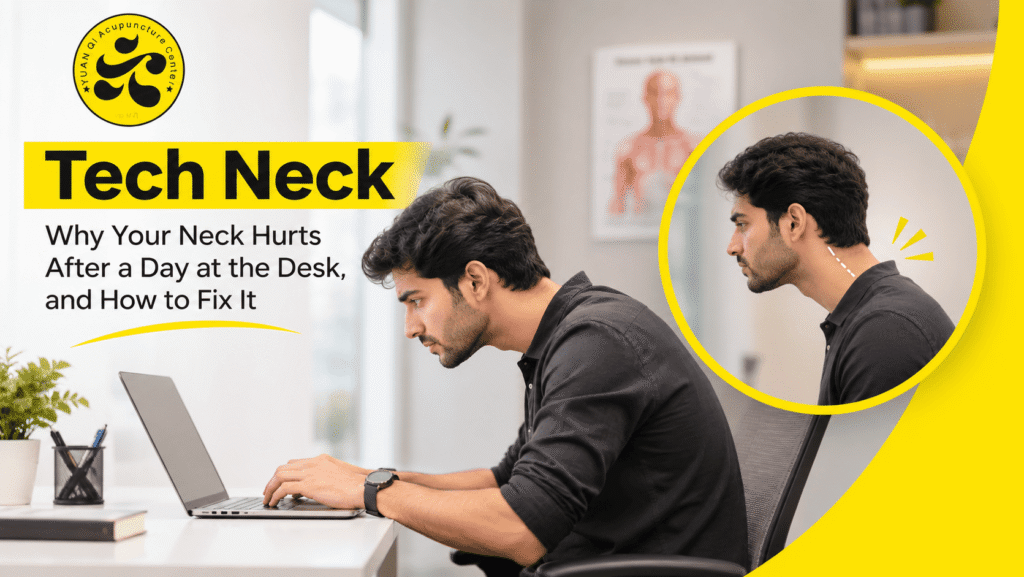
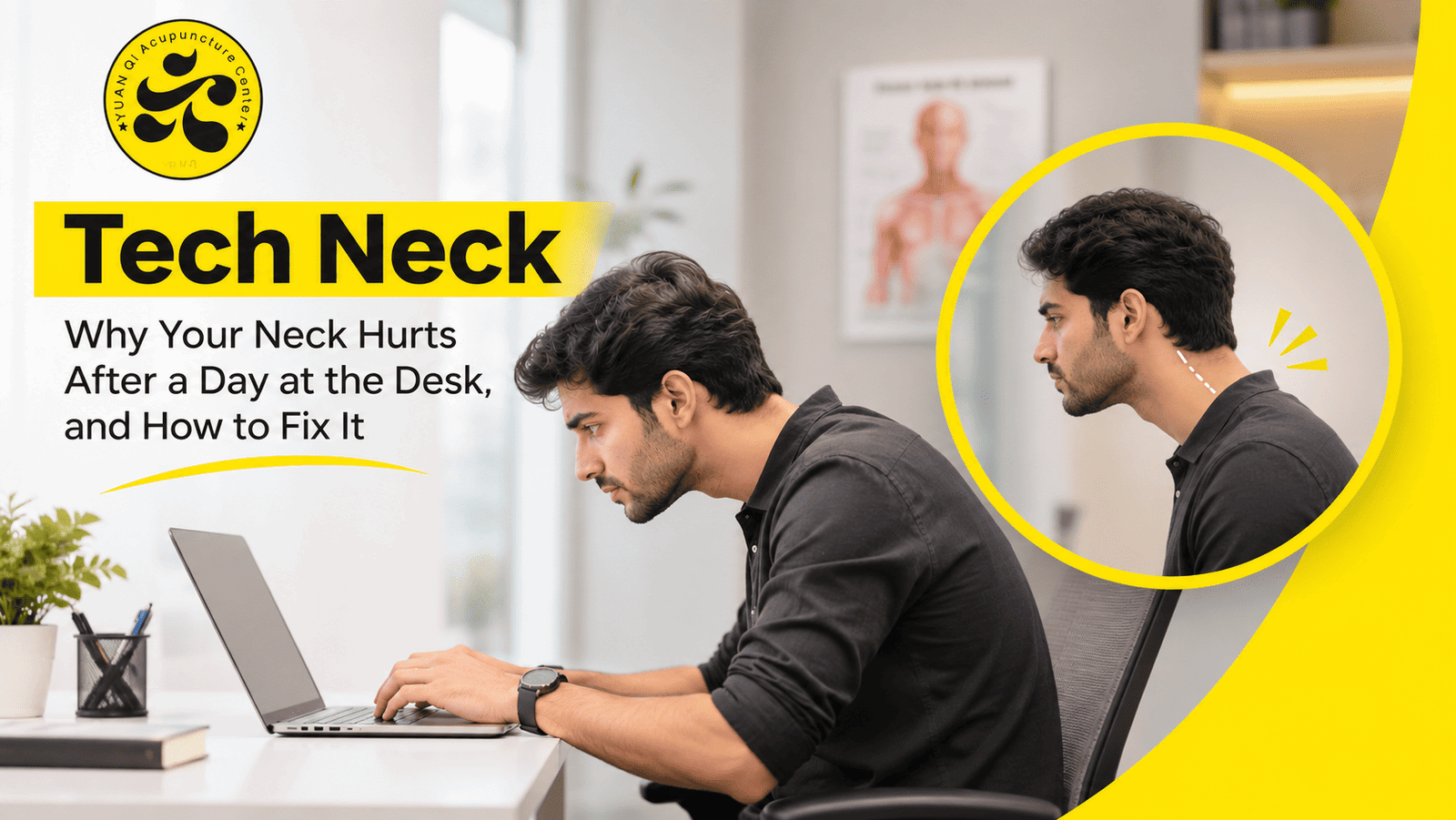
If your neck aches by mid-afternoon, your shoulders sit somewhere near your ears by the time you leave the office, and a headache creeps in on the drive home, you are probably dealing with tech neck. It is not a formal diagnosis. It is a useful name for a very common pattern: neck and upper back pain that builds up from hours spent looking down at laptops and phones.
We see it constantly at our clinic in Business Bay, a short walk from towers full of people who spend the day at a screen and an hour in the car either side of it. It is one of the most common reasons people come to us for neck and back pain treatment. The good news is that tech neck usually responds well to simple changes, and when it does not, there is plenty that can help.
What is tech neck?
Tech neck, also called text neck, describes the strain that builds up when your head spends long stretches tilted forward and down. Your head is heavy, and it is designed to sit balanced on top of your spine. The further it drifts forward, the harder the muscles at the back of your neck and across your upper back have to work to hold it there.
Over weeks and months, those muscles get tired, tight and sore, while the muscles at the front of the neck and chest get short and lazy. The result is a posture often called forward head posture: chin poking forward, upper back rounding, shoulders rolling in. It is the shape most of us make when we are concentrating on a screen.
The NHS lists poor posture, such as sitting at a desk for long periods, as one of the common causes of neck pain and a stiff neck. This kind of neck strain is exactly that cause, made worse by the fact that most of us now also look down at a phone for hours outside work.
Tech neck symptoms: how do you know you have it?
It tends to build slowly and is usually worse at the end of the day or the end of the week. Common signs include:
- A dull ache or stiffness in the neck, especially after long screen sessions
- Tight, sore muscles across the tops of the shoulders and between the shoulder blades
- Headaches that start at the base of the skull and spread over the head or behind the eyes
- Reduced movement when turning your head to check a blind spot
- Pain or tightness in the jaw, especially if you also clench your teeth when concentrating
- Feeling that you need to crack or stretch your neck constantly
- Poorer sleep because you cannot get comfortable
A quick self-check
Stand with your back against a wall, heels a few centimetres away from it, and let your shoulders and upper back touch the wall. If the back of your head does not naturally touch the wall without tipping your chin up, your head is probably sitting forward of where it should be. It is not a diagnosis, but it is a useful clue.
What causes tech neck in Dubai?
Screen-related neck strain is a global problem, but a few things about life in Dubai make it especially common:
- Long desk days, often on a laptop with the screen well below eye level
- Long drives, sitting still with the head pushed forward and the shoulders braced, sometimes twice a day
- Phones used for work as well as everything else, so the head is down for hours outside the office
- Air conditioning blowing directly on the neck and shoulders, which many people find makes stiffness worse
- Less walking and moving through the day, particularly in the hotter months
- Stress and long hours, which tend to show up as tight, raised shoulders
Traditional Chinese Medicine has its own way of describing that last part. A neck that stiffens after sitting under a cold air conditioning vent is often described as an invasion of wind and cold into the channels of the neck and upper back, which is one reason warmth-based therapies are used for it. Whichever way you look at it, the advice is the same: do not let a cold draught blow directly on your neck all day.
Can tech neck cause headaches?
Yes, very often. Tight muscles at the top of the neck and the base of the skull can refer pain upwards, producing a headache that wraps around the head or settles behind the eyes. These are usually tension-type headaches, and many desk workers notice that their headaches build through the working day.
Not every headache is from the neck, though, and frequent headaches are worth having checked. If yours feel more like migraines, with throbbing pain, nausea or sensitivity to light, our page on migraines and chronic headaches explains how we approach them.
How to fix tech neck at your desk
The single most useful change is to bring the screen up to your eyes rather than bringing your eyes down to the screen. Small adjustments to your setup add up over a working week:
| What to change | Why it helps |
| Top of the screen at roughly eye level | Keeps your head balanced over your shoulders instead of tipping down |
| Laptop on a stand, with a separate keyboard and mouse | A laptop alone forces you to choose between a good neck and good arms |
| Screen about an arm’s length away | Stops you leaning in to read |
| Chair height so your feet are flat and hips slightly above knees | Supports a more upright spine without effort |
| Lower back supported against the chair | Reduces slumping, which pushes the head forward |
| Phone brought up towards eye level | Cuts the hours of looking straight down |
| Headset or speaker for long calls | Avoids cradling the phone between ear and shoulder |
| Desk out of the direct path of the air conditioning vent | Many people find a cold draught on the neck makes stiffness worse |
Move more often than you think you need to
Even a perfect setup will not save you if you sit still for three hours. Aim to change position or get up every 30 to 45 minutes, even if only to refill your water or take a call standing. Movement is what keeps the neck from settling into one tired position.
In the car
Bring the seat closer and more upright so you are not reaching for the wheel, and adjust the headrest so it sits close to the back of your head. Let your shoulders drop at red lights. On long drives, stop and move if you can.
Tech neck exercises you can do every day
These five exercises target the muscles that long screen hours tighten and the ones it weakens. They take about five minutes in total. Do them gently, aim for a mild stretch rather than pain, and stop if you feel pins and needles, dizziness or pain spreading into the arm.
- Chin tucks: sitting tall, gently glide your chin straight back, as if making a double chin, without tipping your head down. Hold for 5 seconds and repeat 10 times. This is the most important one.
- Upper trapezius stretch: sitting on your right hand, gently tilt your left ear towards your left shoulder until you feel a stretch on the right side of the neck. Hold for 20 to 30 seconds, then switch sides.
- Doorway chest stretch: place your forearms on either side of a door frame at shoulder height and step gently forward until you feel a stretch across the chest. Hold for 20 to 30 seconds.
- Shoulder blade squeezes: draw your shoulder blades back and down, as if tucking them into your back pockets. Hold for 5 seconds and repeat 10 times.
- Upper back extension: sitting in a chair with a backrest at mid-back height, clasp your hands behind your head and gently arch your upper back over the top of the chair. Repeat 5 to 10 times.
- Little and often beats one long session. Doing chin tucks and shoulder blade squeezes a few times through the working day, at your desk, makes more difference than a big stretch once a week. A physiotherapist can check your technique and adjust the exercises to suit your neck.
Self-care when your neck flares up
Most neck pain settles within a few weeks. When yours flares up, the NHS suggests some simple steps:
- Use a low, firm pillow rather than a stack of soft ones
- Try heat, such as a hot water bottle wrapped in a towel for about 20 minutes two or three times a day, or a wrapped cold pack for about 5 minutes if that feels better
- Keep your neck gently moving rather than holding it still
- Avoid wearing a neck collar unless a doctor has advised one
- Take care with driving or cycling if you cannot turn your head properly
Sleep matters more than people expect. If neck pain is keeping you awake, or poor sleep is making the pain feel worse, our page on sleep problems covers how we help with that side of it.
When should you see a doctor about neck pain?
See a doctor if your neck pain has not improved after a few weeks, painkillers are not helping, or you are worried about it. Get medical help promptly if you have:
- Pins and needles, numbness or weakness in the arms or hands
- Pain spreading down one arm
- Problems with balance, coordination or walking
- Neck pain after a fall, a car accident or any injury
- A stiff neck with fever, a severe headache, a rash or sensitivity to light. This needs emergency care.
- Neck or shoulder pain with chest pain, breathlessness or sweating. Call emergency services.
Desk-related neck pain is common and usually harmless, but it should not be assumed. A proper assessment rules out other causes first.
How we treat tech neck at Yuan Qi
It has two sides: a mechanical side (posture, weak and tight muscles) and a tension side (stress, poor sleep, a nervous system that never really switches off). We treat both, which is why patients often see both our physiotherapist and our doctor of Traditional Chinese Medicine.
Physiotherapy
Dr. SuryaLakshmi starts with an assessment of how your neck, shoulders and upper back move, then builds a plan around exercises, manual therapy and practical changes to your desk and driving. Physiotherapy is the backbone of fixing it for good, because it deals with the posture and strength behind it.
Dry needling
Where tight trigger points in the upper trapezius or around the shoulder blades are driving the pain, dry needling can release them so the exercises become easier to do. If you are not sure how it differs from acupuncture, we explain it in dry needling vs acupuncture.
Acupuncture
Dr. Jun Huang, our DHA and MOH licensed doctor of Traditional Chinese Medicine, uses acupuncture as complementary care for the pain and muscle tension, and for what often sits behind it: stress and broken sleep. Many people find the sessions deeply relaxing. If stress is a big part of your picture, our page on stress and anxiety explains how we approach it.
Hands-on therapies
Tight upper back and shoulder muscles often respond well to hands-on work. Depending on what suits you, that may be Tui Na Chinese medical massage, cupping, Gua Sha or sports massage. If you are weighing up cupping options, our guide to cupping vs Hijama explains the difference.
If your pain is more in the shoulder joint itself than the neck, and the shoulder is getting stiffer, it may be something else. Our shoulder pain treatment page covers how we help.
Tech neck: the short version
- Tech neck is neck, shoulder and upper back pain from holding the head forward and down for long periods.
- Signs include a stiff neck, tight shoulders and headaches at the base of the skull.
- Raise your screen, move every 30 to 45 minutes, and keep the air conditioning off your neck.
- Five minutes of daily exercises, especially chin tucks, makes a real difference.
- See a doctor for arm symptoms, problems with balance, pain after injury, or neck stiffness with fever.
- If it keeps returning, physiotherapy, dry needling, acupuncture and hands-on therapies can help.
Wondering what treatment would cost? Our guide to acupuncture cost in Dubai sets out our prices and how insurance claims work. If you want more background on needling for pain lower down the spine, read does acupuncture help back pain.
Neck aching by mid-afternoon?
Call or WhatsApp us on +971 50 288 4479, or book an assessment online. We are in Business Bay, a short trip from Downtown, DIFC and Al Wasl.
FAQ
- What is tech neck?
Tech neck is neck, shoulder and upper back pain caused by holding the head forward and down for long periods, usually while looking at a laptop or phone. It is also called text neck.
- What are the symptoms of tech neck?
Common symptoms are neck stiffness and aching, tight shoulders, pain between the shoulder blades, headaches at the base of the skull, reduced head movement and sometimes jaw tension.
- Is tech neck the same as text neck?
Yes. Tech neck and text neck describe the same pattern of neck and upper back strain from looking down at screens.
- What is forward head posture?
It is when the head sits forward of the shoulders instead of balanced on top of them, often with rounded shoulders and upper back. It is the posture most linked with tech neck.
- Can tech neck cause headaches?
Yes. Tight muscles at the top of the neck can refer pain into the head, often causing tension-type headaches that build through the working day. Frequent headaches should still be checked.
- How long does it take to fix tech neck?
Many people feel better within a few weeks of changing their setup and doing daily exercises. Long-standing posture habits take longer to change, so consistency matters more than intensity.
- Can tech neck be reversed?
In most people the pain and stiffness improve well with better posture habits, regular movement and strengthening. How much the posture itself changes varies from person to person.
- What are the best tech neck exercises?
Chin tucks, upper trapezius stretches, doorway chest stretches, shoulder blade squeezes and upper back extensions over a chair. Do them gently and little and often.
- How often should I do tech neck exercises?
A few minutes daily works better than a long weekly session. Chin tucks and shoulder blade squeezes can be done several times a day at your desk.
- What is the best monitor height to avoid tech neck?
The top of the screen should be at roughly eye level, about an arm’s length away. Laptop users usually need a stand plus a separate keyboard and mouse to achieve this.
- Can air conditioning make neck pain worse?
Many people find a cold draught blowing directly on the neck makes stiffness worse. Moving your desk or car vent so it does not blow on your neck is a simple fix.
- Should I use heat or ice for tech neck?
Heat usually feels better for stiff, tight muscles: a wrapped hot water bottle for about 20 minutes. Some people prefer a wrapped cold pack for about 5 minutes during a flare-up.
- What pillow is best for tech neck?
The NHS suggests a low, firm pillow. The aim is to keep your neck in line with your spine rather than propped up or tilted.
- When should I see a doctor about neck pain?
If it has not improved after a few weeks, painkillers are not helping, or you have pins and needles, numbness, weakness, balance problems, pain after injury, or a stiff neck with fever.
- Can physiotherapy help tech neck?
Yes. A physiotherapist can assess your posture and movement, give you targeted exercises, use manual therapy and advise on your desk and driving setup.
- Can acupuncture help tech neck?
Acupuncture is used as complementary care to ease neck pain and muscle tension, and to help with the stress and poor sleep that often come with it. It works best alongside exercise and posture changes.
- Is dry needling good for tech neck?
Dry needling can release tight trigger points in the upper trapezius and around the shoulder blades, which often drive tech neck pain. It is usually combined with physiotherapy exercises.
- Does massage help tech neck?
Massage, including Tui Na, sports massage, cupping and Gua Sha, can ease tight upper back and shoulder muscles. It gives the most lasting benefit when combined with exercises and setup changes.
- Is tech neck covered by insurance in the UAE?
Physiotherapy and acupuncture are covered by some UAE insurance plans, usually by reimbursement. Check your policy, and keep every receipt and treatment summary for your claim.
- How do I book a tech neck assessment at Yuan Qi?
Call or WhatsApp us on +971 50 288 4479 or book online. No referral is needed, and your first visit starts with an assessment.